
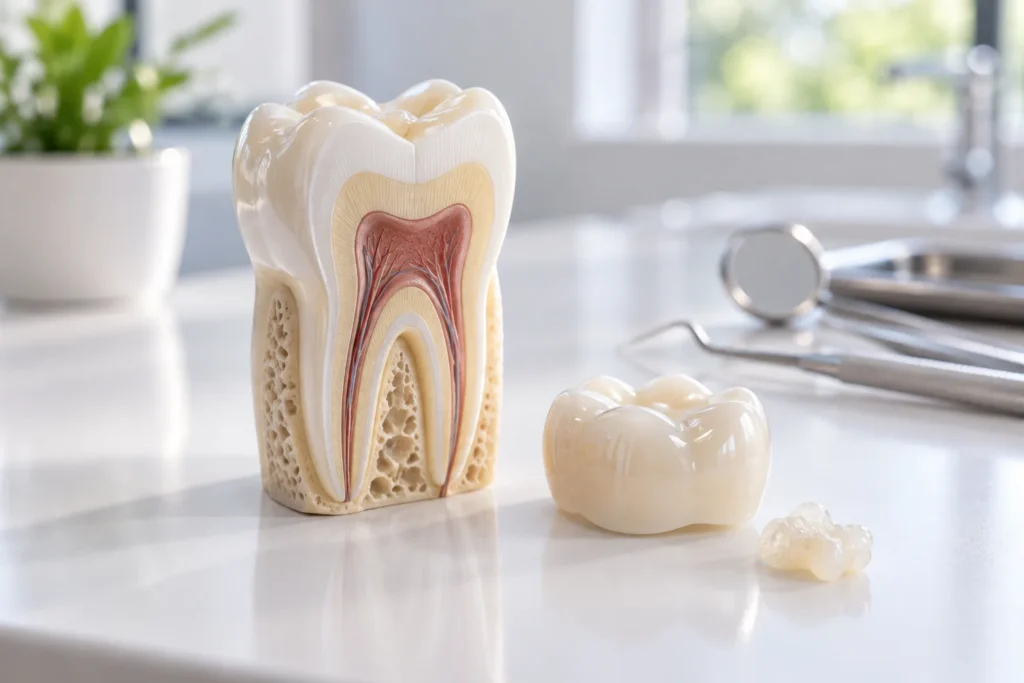
The crown vs filling choice comes down to how much healthy tooth structure remains. A filling repairs a small area of tooth decay, while dental crowns cover and support a tooth that has lost more. Dr. Lernor weighs the damage, your bite and the tooth's job before recommending either.
By Dr. Eric Lernor, DDS, Family Dentist, Lernor Family Dental
Crown vs filling: what is the difference?
A filling replaces the part of a tooth that decay or a crack has taken away. Your dentist removes the damaged area, then fills the space with a material that hardens in place. A crown works differently. After the dentist shapes the tooth, the crown covers the visible part and holds the remaining tooth structure together. Once the crown tooth preparation is finished, a lab builds the restoration from impressions or scans.
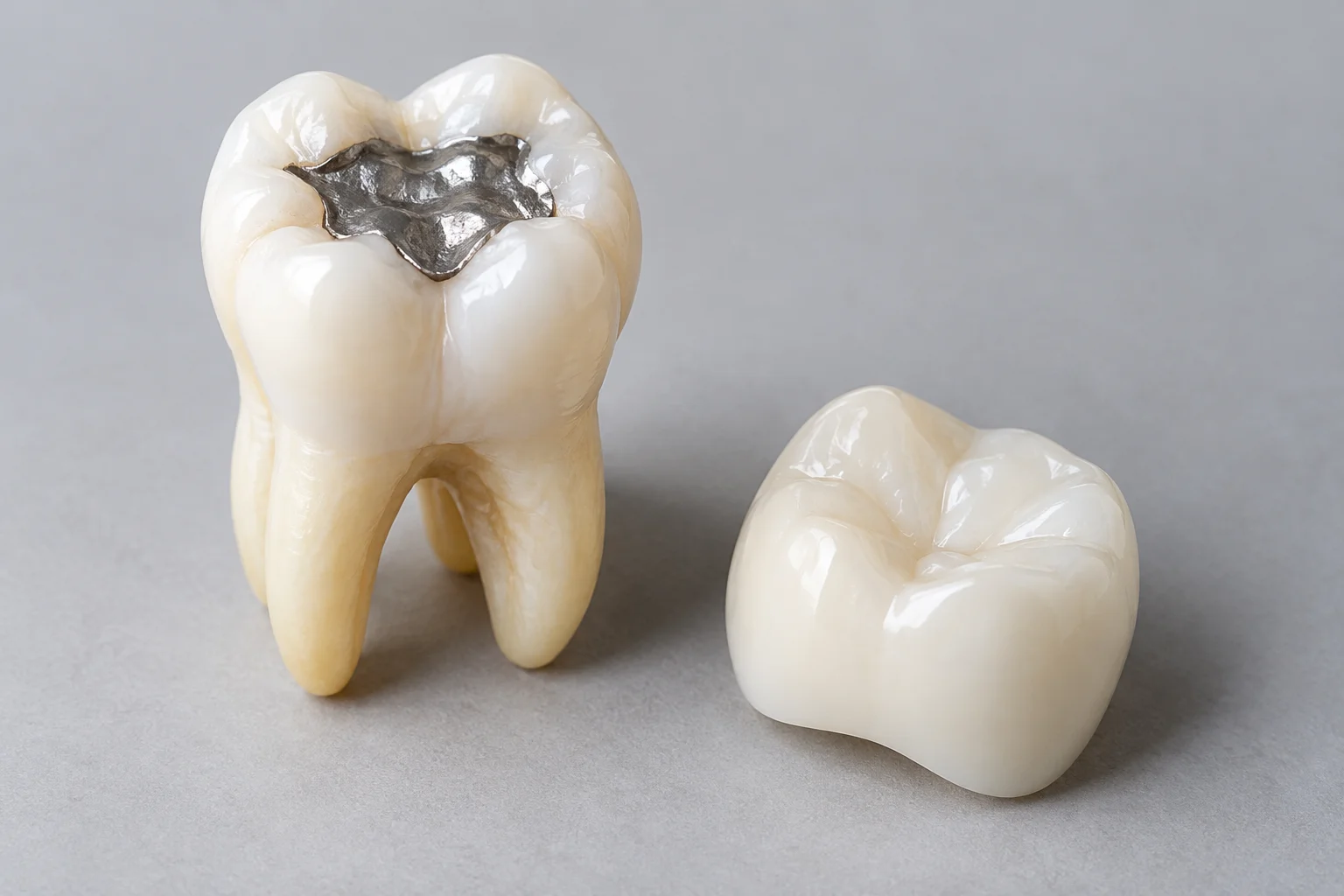
Most dental fillings use composite resin, a tooth-colored blend of plastic and glass. Composite fillings bond to enamel, the hard outer layer of a tooth. Amalgam, a silver-colored metal blend, is an older filling material. A dental crown is usually made of porcelain, a ceramic that can match your natural tooth color, or of metal. The American Dental Association (ADA) describes dental crowns as covers that restore a damaged tooth's shape, size and strength.
| Filling | Crown | |
|---|---|---|
| What it does | Repairs a cavity or a small crack | Covers and supports the whole tooth |
| Tooth structure needed | Enough sound tooth around the repair | Works when much of the tooth is gone |
| How it is made | Shaped directly in the mouth | Built from impressions or scans of the prepared tooth |
| Materials | Composite resin or amalgam | Porcelain, metal or a combination |
| Suited to | Small to medium damage | Large damage, cracks, weak cusps (the raised points of a back tooth) |
Crowns and fillings are standard restorative treatments, and both aim to keep your natural tooth in place. Dental fillings handle small repairs; dental crowns handle the big ones.
Tooth cap vs crown: is a cap different from a dental crown?
No. 'Cap' is everyday shorthand for the same thing. We say crown, and so does the rest of the dental profession. Either word describes one restoration that fits over a tooth the dentist shapes. A crown on a tooth may be porcelain, metal or a mix of both.
What We Look For Before Choosing
Every damaged tooth gets the same starting questions: how much sound tooth is left, where is the damage, and what will the tooth face every day? The answers decide between a filling and a crown.
When do you need a crown instead of a filling?
You usually need a crown when too little healthy tooth remains to hold a filling. A large filling that spans most of a chewing surface leaves thin walls of enamel, and those walls can break under bite force. A crown suits teeth with deep cracks, worn teeth that need their shape rebuilt, and teeth weakened by a root canal. A root canal is a procedure that cleans the inside of a tooth, and it is a separate treatment from a crown or a filling. Afterward, we often place a crown on the tooth to protect what is left.
What are the signs a tooth needs a crown?
Only an exam and x-rays confirm it, but these are the signs a tooth needs a crown that patients notice most often:
- A filling that keeps chipping, loosening or falling out
- A crack you can feel with your tongue, or a sharp twinge when you release a bite
- A cavity (a hole in the tooth) that has taken most of a chewing surface
- Lingering sensitivity to hot, cold or sweet foods
- A tooth that looks worn, chipped or thin at the edges
Many teeth with serious tooth damage give no warning at all, so routine x-rays matter.
Large filling vs crown: which holds up better on a big cavity?
On a big cavity, a crown usually holds up better than a large filling. It swaps a lot of natural tooth for a material that is weaker than enamel, and the walls left behind take the full force of chewing. A crown wraps those walls and spreads that force across the whole tooth. On a small or medium cavity the answer flips. Dental fillings keep more of your natural tooth, because shaping a tooth for a crown removes healthy structure too. We do not reach for a crown by default.
How does a dentist decide how much of a tooth to rebuild?
We start with the tooth and the x-rays, then weigh four things:
- How much sound tooth structure is left once the decay is removed
- Where the tooth sits, since back molars carry more bite force than front teeth
- Whether cracks run through the tooth
- The health of your gums and the way your teeth meet
The goal is the smallest restoration that does the job. Since 2003, we have run Lernor Family Dental as a privately owned practice, so the person who plans your restoration knows your history.
If one of these signs sounds familiar, our Restorative Dentistry team can check the tooth at a $49 new patient exam with x-rays; call 602-485-4747 to set it up.
Filling vs Crown Cost: What Moves the Number?
Filling vs crown cost has no flat answer here, because we do not post a price for fillings or crowns. Our published fee for a new patient exam and x-rays is $49, and that visit is where we learn what the tooth needs. After the exam, the fee follows what we find. These factors move it:
| What moves the fee | Filling | Crown |
|---|---|---|
| Size of the damage | More surfaces mean more material and time | More tooth to rebuild or support underneath |
| Material | Composite resin or amalgam | Porcelain, metal or a combination |
| Lab work | Usually none | Made from impressions or scans of the prepared tooth |
| Extra steps | Sometimes a liner under a deep filling | Sometimes a filling under a crown to build up the core |
Patients sometimes ask whether a high quote for a crown or filling is fair. Prices vary by office, material and lab, so compare what each quote includes: the exam, the material, the lab work, the fitting visits and the follow-up. Some plans use a filling crown pairing, where a filling rebuilds the core and the crown covers it.
Waiting changes the math too. Dr. Lernor's rule is that preventive care is very inexpensive and leads to lower overall cost of care. Small decay found at a checkup is usually a small filling, which is why regular dental cleanings and exams matter for your oral health and your budget.
Mistakes That Turn a Small Repair Into a Big One
The biggest mistake is waiting for pain. Early decay often hurts nothing, and by the time a tooth aches, the damage may sit close to the nerve.
Can a tooth with a large filling still need a crown later?
Yes. A big filling can hold for years, but the tooth around it can crack, or new decay can start at its edge. When the walls thin out, we may suggest replacing the filling with a crown. A filling is sometimes a stage on the way to a crown, not always the final restoration.
Can a tooth still rot under a crown?
Yes. A crown covers the tooth, but it does not make the tooth immune. Tooth decay can start where the crown meets the tooth near the gumline, because plaque collects along that edge. Brushing, flossing and regular exams keep that edge clean and watched.
How do a crown, a filling and a root canal compare?
A root canal is a separate treatment for infection or damage inside the tooth, and it is not part of the crown-or-filling decision covered here. Decay that reaches the nerve (swelling, deep throbbing or lingering heat sensitivity can point that way) may move the question from filling or crown to a root canal, which is why catching decay early matters. People also ask which hurts more, a root canal or a crown. Dr. Lernor's answer is that local anesthetic, used in specific ways, removes most if not all pain from dental procedures. If you have swelling or severe pain, call 602-485-4747; we offer a $19 emergency exam.
Matching the Choice to Your Situation
Filling or crown: which is right for my tooth?
Only an exam can say, but these common situations show how the crown vs filling decision usually runs:
| Your situation | What often fits | Why |
|---|---|---|
| Small cavity found at a checkup | Filling | Keeps the most natural tooth |
| Large cavity on a back molar | Crown, sometimes after a filling to rebuild the core | Back teeth take the most bite force |
| Cracked or broken cusp | Crown | Holds the pieces together |
| Old filling that is failing | New crown | Walls may be too thin to hold another filling |
| Tooth weakened by a root canal | Crown | Protects the remaining tooth |
Composite fillings and tooth-colored porcelain both aim to give natural-looking smiles, so appearance rarely forces the choice. Function does. Both treatments work best when the plan restores the tooth with the least loss of natural tooth structure, which keeps smiles looking natural.
Get a Straight Answer on Your Tooth
We see patients from Phoenix, Scottsdale, Cave Creek and Paradise Valley at our office on E. Greenway Road. Call 602-485-4747, or use the website form to Request an Appointment.