
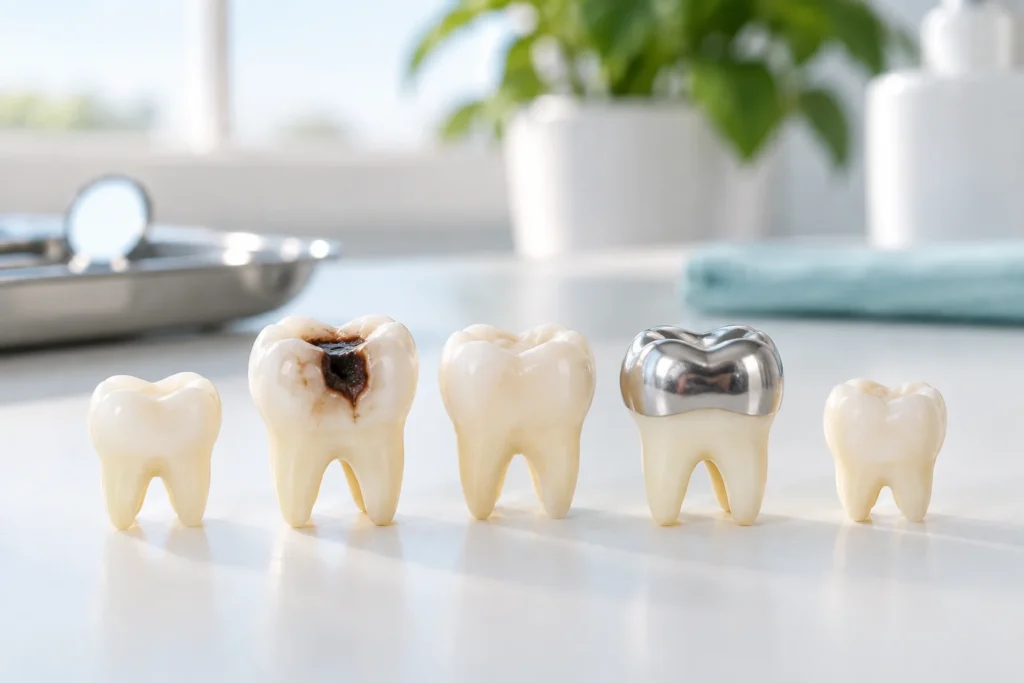
When your child has a big cavity, the fix depends on how much healthy tooth structure remains: a filling can still work for moderate decay, a crown protects a badly broken tooth, and extraction is reserved for teeth too damaged to save through Restorative Dentistry.
By Lernor Family Dental Team, Scottsdale Dentists
How Dentists Decide Between a Filling, a Crown, or Pulling a Baby Tooth
A dentist looks at three things before recommending treatment options for tooth decay in a baby tooth: how much healthy enamel and dentin remain, whether the decay has reached the nerve, and how close the tooth is to falling out on its own. A cavity confined to one surface with solid walls around it usually gets a filling. A cavity that has spread across several surfaces, or left the tooth structurally weak, usually needs a crown to survive normal chewing. A tooth with extensive decay below the gumline, active infection, or a root that can't be repaired is often pulled. The decision to see a pediatric dentist or family dentist for this work often comes down to your child's comfort level, anxiety, and how complex the case is, since both offer pediatric dental care and are trained in pediatric dentistry, though some kids do better with a practice built entirely around children.
Can a Filling Still Fix a Large Cavity in a Baby Tooth?
Often, yes, as long as at least two solid walls of the tooth remain to hold the filling in place. Dentists use tooth colored composite for these repairs in baby teeth. If the decay has already broken down most of the tooth's structure, a filling won't have enough to bond to and the tooth needs a crown instead. This is one of the areas where a same day exam matters: the size of the cavity often looks different on an X-ray than it does on the surface.
When a Baby Tooth Needs a Crown Instead of a Filling
A stainless steel crown covers the entire visible tooth rather than patching one damaged area, which makes it the stronger choice for molars carrying heavy chewing forces or teeth with decay on multiple sides. Crowns are also common after a pulpotomy, since the tooth is weaker once the nerve tissue inside has been treated. Tooth colored crowns are available for front teeth, where appearance matters more to families.
When a Badly Decayed Baby Tooth Needs to Be Pulled
Extraction is a last resort, used when the tooth has decayed below the gumline, the infection has spread into the surrounding bone, or the root has broken down enough that no filling or crown could hold. A dentist will usually try to save a baby tooth first, since it holds space for the permanent tooth underneath, but a tooth that's actively infecting the gums or the child's health puts removal ahead of restoration.
If Your Child Has a Big Cavity, Does It Mean a Root Canal (Pulpotomy)?
Not always. A root canal style procedure, called a pulpotomy, is only needed when decay has reached the nerve (pulp) inside the tooth. During a pulpotomy, the dentist removes the infected pulp tissue from the crown portion of the tooth, treats the remaining healthy pulp in the root, and places a crown over the top to seal and protect it. It's a shorter, gentler procedure than an adult root canal, and it's specifically designed to keep a baby tooth in place until it's ready to fall out naturally.
Signs a Cavity Has Reached the Nerve
Watch for pain that starts on its own rather than only when your child bites down, a toothache that wakes them at night, swelling along the gums, a small pimple like bump near the tooth, or a tooth that has darkened compared to the ones next to it. Any of these signs of tooth decay reaching the nerve is worth a same week evaluation rather than waiting for the next routine visit.
What Happens If a Baby Tooth Is Pulled Too Early
Baby teeth hold the space and guide the eruption path for the permanent tooth underneath. When one is pulled well before it would have naturally come out, neighboring teeth can drift into that open space, which crowds or blocks the permanent tooth trying to come in. This is why a dentist often recommends a space maintainer, a small custom appliance that holds the gap open until the adult tooth is ready to erupt. Skipping that step can mean orthodontic work later that wouldn't otherwise have been needed.

What Treating a Big Cavity Costs and What Insurance Covers
Cost depends on which treatment your child needs: a filling is the least expensive option, a crown costs more because it covers the whole tooth, and a pulpotomy with a crown costs more still since it involves treating the nerve first. Most dental insurance plans cover a meaningful share of fillings and crowns on baby teeth as basic or major restorative care, though the exact percentage varies by plan and by whether your dentist is in-network or out-of-network with your carrier, which can change what actually lands on your bill. Our team can check your plan and walk through what's covered before any work begins. If a big cavity is confirmed at the exam, we map out a plan for a filling, crown, or extraction based on what's healthiest for your child's mouth, and families can Book Appointment to get that exam on the calendar.
Is It Worth Fixing a Cavity in a Tooth That Will Fall Out Anyway?
Yes, in almost every case. If your child has a big cavity in a tooth that will eventually fall out on its own, that tooth is still doing a job: chewing, holding space for the permanent tooth, and in front teeth, supporting speech development. An untreated cavity doesn't stay contained, it keeps spreading through the enamel and dentin, can reach the nerve, and can turn into an infection that affects the developing permanent tooth underneath. Brushing twice daily with fluoride toothpaste and cutting back on sugary snacks and drinks can slow new decay while you're waiting on a treatment date, but it won't reverse damage that's already there. Treating the cavity now is almost always simpler, and more comfortable for your child, than treating an infection later.
Sedation Options for a Large Cavity in a Child
Most fillings and even most crowns are done with local anesthesia alone, the same numbing most adults get, and many kids tolerate it well with some reassurance and a little distraction. For a child who's anxious, very young, or facing more than one procedure in the same visit, nitrous oxide (a mild, fast acting gas that helps them relax) is a common next step. More involved cases, several teeth needing treatment at once, a very young or especially anxious child, or a pulpotomy combined with a crown, may call for oral conscious sedation or general anesthesia in a hospital or surgical setting. Which option makes sense depends on your child's age, anxiety level, and the scope of treatment, and it's worth discussing directly at the exam rather than assuming the most involved option is required.
How Long a Baby Tooth Crown Lasts
A crown on a baby tooth is built to last until that tooth naturally falls out to make room for the permanent tooth, which for back molars can be several years away. Stainless steel crowns are especially durable against the chewing forces of childhood and rarely need replacement before the tooth exfoliates on its own. The main things that shorten a crown's life are trauma, like a fall or hard impact, or gum disease around the crown from skipped brushing, both of which your dentist checks for at routine visits.
Frequently Asked Questions
Can a cavity in a baby tooth get worse quickly?
Yes. Baby teeth have thinner enamel and dentin than permanent teeth, so tooth decay can spread from a small dark spot to a large cavity in a matter of months rather than years. A cavity that looked minor at one visit can be significantly bigger by the next, which is part of why dentists recommend addressing decay as soon as it's found instead of waiting.
Does my child need antibiotics for a big cavity?
Only if there's an active infection with swelling, fever, or a gum abscess. Antibiotics can calm an infection short term, but they don't remove the decayed tooth structure or repair the tooth, so a filling, crown, pulpotomy, or extraction is still needed afterward to treat the actual cavity.
What's an early sign of a big cavity I can spot at home?
Look for dark spots or visible holes on the chewing surfaces or between teeth, complaints of pain while eating, or your child chewing mostly on one side of the mouth. Bad breath that doesn't improve with brushing can also point to decay that's already progressed.
Is a silver crown or a white crown better for my child's baby tooth?
Stainless steel (silver) crowns are the stronger option for back molars, which take the most chewing force. Tooth colored crowns are available for front teeth, where families often prioritize appearance, and your dentist can recommend which fits the location and extent of damage best.
Schedule Your Child's Cavity Exam in Scottsdale
A big cavity gets easier to treat the sooner it's caught, and harder the longer it waits. Contact our Scottsdale team to schedule an appointment and get a clear treatment plan for your child's tooth.