
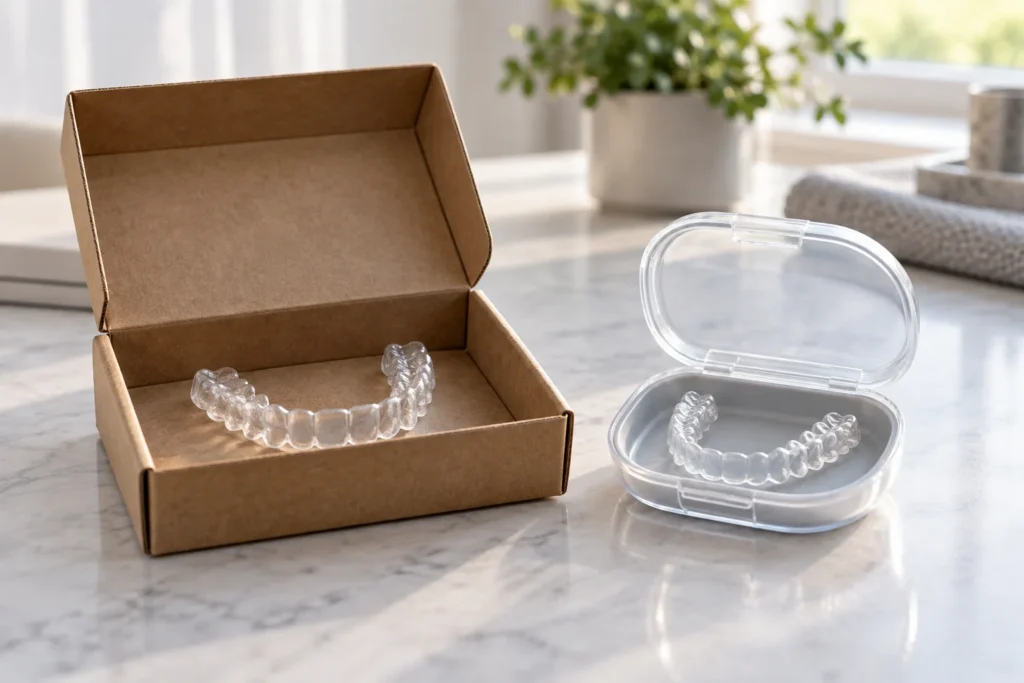
Choosing between mail order clear aligners or dentist supervised Invisalign comes down to one real question: who is watching your teeth move? Mail order kits ship a full tray series based on a single scan, while dentist supervised Invisalign treatment adjusts as you go, which matters most for Scottsdale adults considering Cosmetic Dentistry beyond a quick fix.
By Lernor Family Dental Team, Scottsdale Dentists
When Scottsdale adults compare mail order clear aligners or dentist supervised Invisalign, the biggest difference comes down to who is watching your teeth move, not just how the trays feel. Mail order kits usually start with an at-home impression kit or a scan at a retail location, then ship a full series of trays based on that single snapshot of your mouth. Dentist supervised Invisalign treatment starts the same way any orthodontic treatment plan should: with a hands-on exam, X-rays, and a dentist mapping out the entire course of tooth movement before the first tray is even printed.
That upfront exam matters because clear aligners work by applying gentle, staged pressure to shift teeth into a new position. Invisalign clear aligner trays are adjusted throughout treatment based on how your teeth actually respond, not just how a computer predicted they would respond months earlier. A dentist supervised plan can course correct mid treatment; a mail order plan generally cannot, because there is no clinician tracking your progress between shipments.
Scottsdale's clear aligner options have expanded well past a single generic tray system, with modern clear aligner materials now engineered for faster, more predictable tooth movement than the mail order kits most people picture.
Is It Safe to Skip an In-Person Exam?
For a small number of adults with very mild, uncomplicated spacing, a remote monitoring model can work reasonably well. But safety depends heavily on the individual case. Gum disease, untreated cavities, a bite that doesn't line up correctly (malocclusion), or a tooth that needs a filling first can all make aligner treatment risky without someone checking your mouth in person. Professional dental groups have raised concerns about direct-to-consumer aligner models for exactly this reason: aligners move teeth, and moving teeth without diagnosing what's underneath them first can quietly make an existing problem worse.
What These Two Paths Cost, Today and Over the Long Run
Mail order clear aligner kits are marketed as the budget option, and for very simple cases, the sticker price is often lower than dentist supervised Invisalign treatment. But the fair comparison isn't the price on the box, it's the price of getting the result you actually wanted the first time.
Dentist supervised Invisalign typically bundles the exam, the X-rays, the treatment plan, and adjustments along the way into one course of orthodontic treatment. Mail order kits usually charge separately, or not at all, for anything that goes wrong: a refinement round because a tooth didn't move as predicted, a retainer once treatment ends, or a dentist visit to fix a problem the kit caused.
Over the long run, an adult who needs a second round of trays, an unplanned dental visit, or a switch to supervised treatment partway through often ends up paying more in total than if they had started with dentist supervised Invisalign in the first place. The lower upfront number on a mail order kit rarely accounts for the cost of redoing work that didn't hold.
Why Some Cases Need X-Rays Before Mail Order Clear Aligners or Dentist Supervised Invisalign Can Start
X-rays show what's happening below the gumline: bone levels, root positions, and hidden decay that a photo of your smile can't reveal. Moving teeth without that information is a little like rearranging furniture in a room you have never actually walked into. If a tooth's root is angled the wrong way, or the bone supporting it is thinner than it should be, forcing tooth movement in that direction can loosen the tooth instead of straightening it.
Cases that usually need an in-person exam and X-rays before starting any aligner treatment include noticeable bite problems, teeth that have shifted after a missing tooth, moderate to severe crowding, or a history of gum disease. If your case includes any of these, mail order clear aligners are usually not the safer starting point.
A same-visit exam through General Dentistry can tell you within one appointment whether your case is straightforward enough for a lighter-touch aligner plan, or whether it needs the closer supervision that comes with dentist supervised Invisalign, before you spend anything on a mail order kit.
How Long Treatment Takes With Each Approach
Dentist supervised Invisalign treatment for adults commonly runs from several months to around a year and a half, depending on how much tooth movement your case needs and how consistently you wear your trays. Because a dentist checks progress at scheduled visits, the timeline can flex in real time. If teeth are moving faster or slower than expected, the plan adjusts instead of continuing on autopilot.
Mail order kits are often marketed with a shorter timeline for mild cases, sometimes just a few months. In practice, that estimate reflects your original scan, not a guarantee, and there is no clinician available to shorten or extend it if your teeth respond differently than predicted. Some people finish on schedule. Others find their timeline stretches once they are several weeks in, with no one available to explain why or adjust the plan.
What Happens If Something Goes Wrong, and Can You Switch Paths Later
With dentist supervised Invisalign, a sore spot, a tray that isn't tracking, or a tooth moving slower than planned gets addressed at your next visit, or sooner if it's uncomfortable. With mail order aligners, there is usually no dentist attached to your case at all, just a call center or a support ticket. If a tray causes pain, doesn't fit, or teeth start moving in a direction that doesn't match your face, you are often left deciding on your own whether to keep wearing it, pause, or see a dentist you didn't start with to fix it.
Choosing between mail order clear aligners or dentist supervised Invisalign now doesn't lock you into that path forever. Adults switch from an at-home kit to a supervised plan fairly often, usually after a refinement doesn't work as expected or teeth stop moving the way the original scan predicted. Bringing your aligners and any records you have to an exam gives a dentist a starting point to evaluate what has already changed and build the rest of your orthodontic treatment plan around it, rather than starting completely over in every case.
Frequently Asked Questions
Does dental insurance cover Invisalign but not mail order aligner brands like Byte or SmileDirectClub?
Many dental insurance plans that include orthodontic benefits will apply them to dentist supervised Invisalign treatment because it's billed as a professional orthodontic service. Mail order brands like Byte or SmileDirectClub are often structured as consumer products rather than dental treatment, so insurance frequently won't cover them at all, and network status can change what you owe even when a plan does cover Invisalign.
Can adults with mild crowding use mail order clear aligners safely?
Mild, uncomplicated crowding is generally the best-case scenario for a mail order kit, and some adults do fine with it. But mild is a clinical judgment, not something you can confirm from a selfie or an at-home impression kit. Without X-rays or a dentist checking gum health and root position first, a case that looks mild can still involve an underlying issue that changes the safest way to move those teeth.
What if my teeth do not move the way my aligners predicted?
With dentist supervised Invisalign, unexpected tooth movement gets caught and adjusted at a scheduled check-in, often with a new set of trays or a refinement built into the plan. With a mail order kit, there is usually no one monitoring progress between shipments, so a tray that stops tracking correctly can go unnoticed until the whole series is finished and the result doesn't match what was promised.
Is it too late to switch to supervised Invisalign if I already started a mail order kit?
It's rarely too late. A dentist can typically evaluate where your teeth are now, compare it to where your original plan intended them to be, and build a new course of orthodontic treatment from that starting point. The sooner it happens after something feels off, the fewer additional aligner sets it usually takes to get your smile back on track.
Find Out Which Aligner Path Fits Your Smile
If you're still deciding between mail order clear aligners or dentist supervised Invisalign, a same-visit exam can tell you which path actually fits your teeth before you commit to either one. Book Appointment with our Scottsdale team to get X-rays, a bite check, and a straight answer on your best option.